
![Mitsubishi Triton [2025]](https://www.motaauto.com/wp-content/uploads/2026/08/Mitsubishi-Triton-2025-61.jpg "Mitsubishi Triton [2025]")
Team Mitsubishi Ralliart’s second consecutive overall victory at the Asia Cross Country Rally (AXCR) this year provided a clear validation of the engineering work invested in the all-new platform for the Triton introduced 3 years earlier.
The 2026 event tested the refined rally specification, which incorporated further adjustments to weight distribution and component durability drawn from the previous year’s experience.
While defending champion Chayapon Yotha encountered punctures and mechanical issues that dropped him down the order, the Taguchi-Yasui crew maintained a measured pace over 6 days and more than 2,000 kms challenging terrain in Thailand to maintain a slender advantage to the finish.
![Mitsubishi Triton [2025]](https://www.motaauto.com/wp-content/uploads/2026/08/Mitsubishi-Triton-2025-4.jpg)
Adapted to demands of AXCR
The consecutive victories demonstrated that the core strengths developed for series production — rigidity, handling stability and resistance to driver fatigue — could be adapted successfully to the extreme demands of the AXCR.
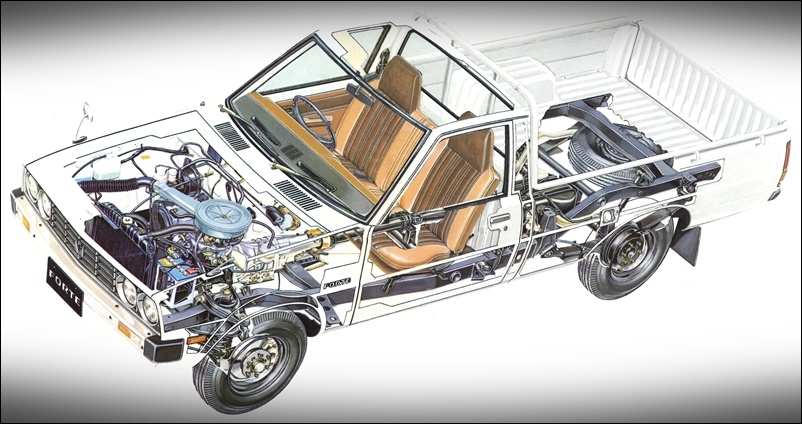
The Triton that achieved these results belongs to a model line that began in 1978. Mitsubishi Motors introduced its first 1-ton pick-up truck that year, sold in Japan as the Forte and exported under names that included the L200.
Dual role
From the outset, the vehicle was required to serve two distinct roles: a durable commercial tool for construction sites, farms and mines, and a practical means of daily family transport in the city.
![Mitsubishi Triton [2026]](https://www.motaauto.com/wp-content/uploads/2026/08/Mitsubishi-Triton-2026.jpg)
More than 5.85 million units have been produced and sold in approximately 150 countries. The Triton nameplate was applied to the fourth-generation model in 2005, with the fifth generation following in 2014. By the early 2020s, the ladder frame that was the truck’s backbone had remained largely unchanged for nearly 2 decades.
Improving an already tough product
When the time came for a full redesign, Hideki Sato of the Project Development Management Department recognised that the existing frame could not deliver the necessary gains in safety performance and body rigidity.
![Mitsubishi Triton [2025]](https://www.motaauto.com/wp-content/uploads/2026/08/Mitsubishi-Triton-2025-1.png)
He initiated a development programme that encompassed an almost complete overhaul of the platform, including a new engine. Nearly 20 years had passed since the major frame development had been undertaken, leaving no engineers with direct experience of that earlier work.
![Mitsubishi Triton [2025]](https://www.motaauto.com/wp-content/uploads/2026/08/Mitsubishi-Triton-2025-1.jpg)
The first prototype that emerged from extensive computer-aided analysis proved barely usable as a vehicle. The subsequent process involved systematic revision of cross-sectional shapes, changes in materials and the elimination of potential failure points one by one.
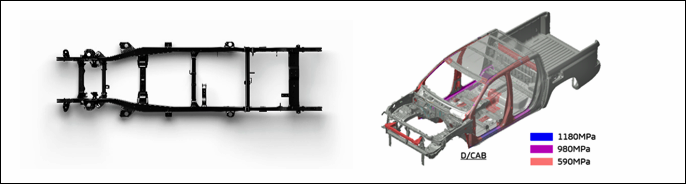
The finished frame increased cross-sectional area by 65% compared with its predecessor. Bending rigidity rose by 60% and torsional rigidity by 40%. Weight increase was limited by raising the proportion of high-strength lightweight steel by roughly half.
![Mitsubishi Triton [2025]](https://www.motaauto.com/wp-content/uploads/2026/08/Mitsubishi-Triton-2025-8.jpg)
The rear suspension was simplified from 5 leafsprings to three, reducing friction, saving approximately 13 kgs per vehicle and improving ride comfort. The new 2.4-litre engine, fitted with a 2-stage turbocharger, produces up to 200 ps and is calibrated to deliver progressive acceleration across the operating range.
Advanced active systems
The 4-wheel drive system combined Super Select 4WD-II, previously used on the Pajero, with Super-All Wheel Control (S-AWC) derived from the Lancer Evolution. This marked the first application of S-AWC to a body-on-frame vehicle. The system adjusts drive force automatically according to surface conditions, allowing the truck to adapt when roads change abruptly.
![Mitsubishi Triton [2025]](https://www.motaauto.com/wp-content/uploads/2026/08/Mitsubishi-Triton-2025-9.jpg)
Attention was also given to reducing driver fatigue on long journeys, important for many operators who may drive across deserts or deep into jungles. Seat adjustment ranges and forward visibility were calibrated so that drivers of widely different heights could maintain precise control with equal confidence.

From launch to rally
The redesigned Triton, made at Mitsubishi Motor’s global Triton production hub in Thailand, made its world premiere in Bangkok in July 2023. Within weeks of the launch, the production-based vehicle was prepared for the AXCR. In 2023, modifications were limited largely to suspension, brakes, tyres, wheels and differentials.
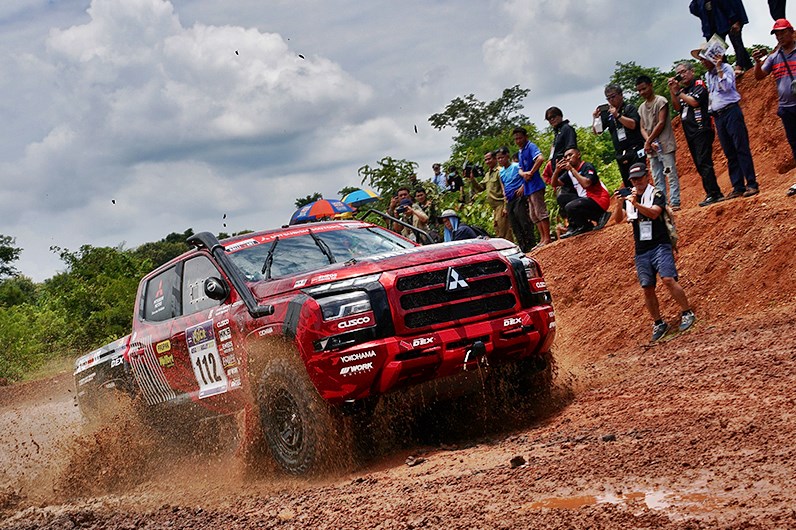
All three vehicles in the team finished, fastest times were set on several special stages, and the Team Award was secured. The inherent stability and resistance to fatigue developed for production use proved decisive assets under rally conditions.
Rally vehicles vs production models
Rally development engineering operates under different priorities from that for production vehicles sold to the public. Components need only remain functional until the event ends, whereas production parts require long-term durability. Failures are examined by materials specialists who analyse fracture surfaces and return the findings to the development process.
![Mitsubishi Triton [2025]](https://www.motaauto.com/wp-content/uploads/2026/08/Mitsubishi-Triton-2025-6.jpg)
Production engineers routinely get involved in the rally programme, providing their expertise as well as collecting data that can be used to advance their production programmes. Thus motorsports activities also benefit the people who own a Triton as some of the technologies developed can be used in production models.
Gaining data from each event
Hiroshi Masuoka, Team Director of Team Mitsubishi Ralliart and 2-time winner of the Dakar Rally, notes that decades of rally experience have been absorbed into the company’s broader engineering culture. Expertise in 4×4 systems, chassis and body durability, off-road capability and safety have been reinforced by extensive data for each rally.
![Mitsubishi Triton [2025]](https://www.motaauto.com/wp-content/uploads/2026/08/Mitsubishi-Triton-2025-10.jpg)
The consecutive AXCR victories of 2025 and 2026 with the latest Triton demonstrated the same process of diagnosis, correction and incremental refinement that produced an entirely new ladder frame which enabled endurance and durability in the tough event.
![Mitsubishi Triton [2025]](https://www.motaauto.com/wp-content/uploads/2026/08/Mitsubishi-Triton-2025-11.jpg)
No doubt many lessons learnt will be passed on to engineers who continue to improve the Triton, giving customers better products in years to come.
Find a showroom to test-drive the latest Mitsubishi Triton
Team Mitsubishi Ralliart wins AXCR for second consecutive year with Triton