
![Ferrari Amalfi Spider [2026]](https://www.motaauto.com/wp-content/uploads/2026/03/Ferrari-Amalfi-Spider-2026-9.jpg "Ferrari Amalfi Spider [2026]")
Quick look
-
Unveiled less than a year after the debut of the Amalfi Coupe, the Spider version arrives as the direct successor to the Roma Spider.
-
The introduction adds an open-air ‘2+’ configuration to the line-up, utilizing a 5-layer fabric soft-top bridges the gap between pure supercars and luxury cruisers.
Positioned at the entry point into Ferrari’s world of open-air grand touring, the Amalfi range serves as the spiritual successor to the Portofino and Roma lines. Within the current range, it sits below the V12-powered 12Cilindri, offering a more accessible and usable alternative to the extreme mid-engine layouts of the 296 or SF90.
Its front mid-engine configuration and 2+ seating arrangement make it versatile for daily use, filling the gap between purebred supercars and high-performance luxury cruisers while upholding the brand’s heritage of V8-powered GTs.
![Ferrari Amalfi Spider [2026]](https://www.motaauto.com/wp-content/uploads/2026/03/Ferrari-Amalfi-Spider-2026-5.jpg)
The new Amalfi Spider is a calculated evolution of the model, formalizing the transition from the Roma era into a more tactile and refined chapter for Ferrari. This open-top 2+ variant seeks to balance the aggressive mechanical layout of a performance machine with the subdued elegance required for long-distance travel.
By maintaining the core architecture of the coupe while introducing a sophisticated soft-top mechanism, the Amalfi Spider targets a specific demographic that prioritizes sensory engagement over track performance.
![Ferrari Amalfi Spider [2026]](https://www.motaauto.com/wp-content/uploads/2026/03/Ferrari-Amalfi-Spider-2026-8.jpg)
Soft top chosen
The silhouette of the Amalfi Spider was engineered to preserve the fluid, minimalist surfaces of the fixed-roof model. Ferrari designers opted for a fabric soft top rather than a retractable hard top, a decision that influences both the car’s weight distribution and its aesthetic profile.
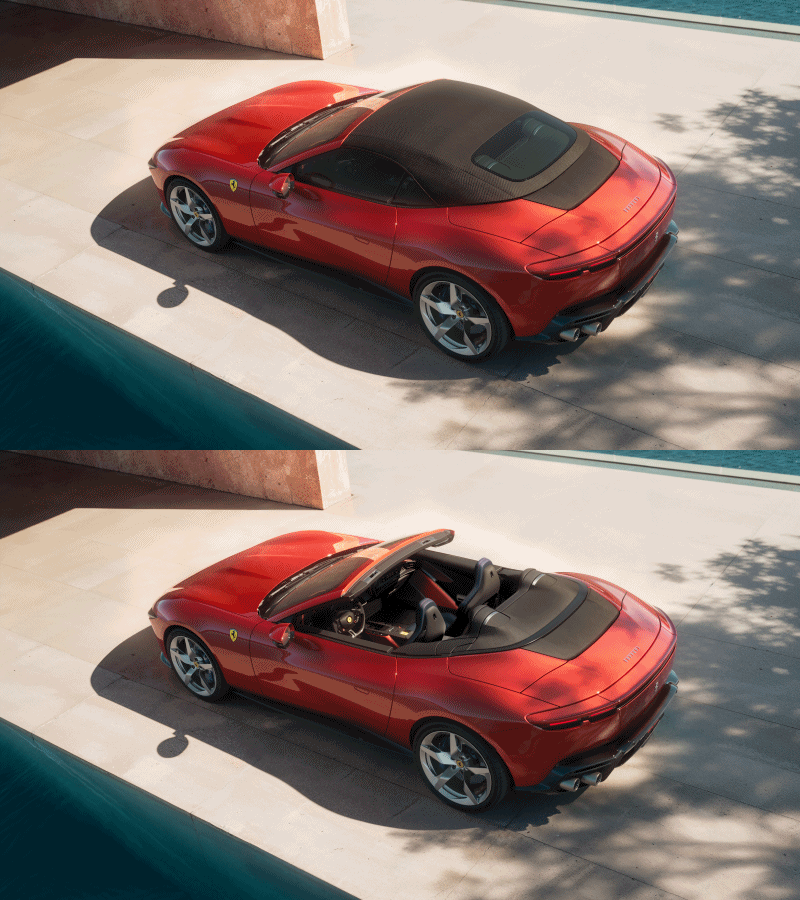
This choice allows the car to maintain a sleek, uninterrupted beltline and a tapering rear deck, avoiding the bulky ‘high-butt’ look often associated with metal folding roofs. The exterior surfaces remain clean, relying on volume and light rather than complex aerodynamic appendages to convey speed.
The soft-top mechanism itself is a technical highlight, capable of retracting or deploying in 13.5 seconds at up to around 60 km/h. When stowed, the roof occupies a vertical space of just 220 mm, a compact footprint that minimizes the impact on rear storage. Even with the roof down, there’s 172 litres of luggage capacity, which expands to 255 litres when the top is raised. This level of utility suggests a focus on practical touring, ensuring that the vehicle remains functional for more than just short-distance spirited driving.
To address the inherent noise and temperature challenges of a fabric roof, there are 5 distinct layers. This construction is designed to provide acoustic and thermal insulation levels that rival traditional hard-top solutions.
Driver-centric cockpit
Inside, the cabin retains the dual-cockpit architecture that separates the driver and passenger into two distinct cells. A significant ergonomic update is the departure from purely haptic interfaces in favour of physical controls on the steering wheel. The return of the tactile start button and the inclusion of more intuitive switchgear represent a response to user feedback regarding previous digital-heavy layouts.
![Ferrari Amalfi Spider [2026]](https://www.motaauto.com/wp-content/uploads/2026/03/Ferrari-Amalfi-Spider-2026-7.jpg)
The central display remains the hub for infotainment, but the primary focus remains on a driver-centric interface that simplifies interaction during high-speed manoeuvres.
![Ferrari Amalfi Spider [2026]](https://www.motaauto.com/wp-content/uploads/2026/03/Ferrari-Amalfi-Spider-2026-1.jpg)
![Ferrari Amalfi Spider [2026]](https://www.motaauto.com/wp-content/uploads/2026/03/Ferrari-Amalfi-Spider-2026-4.jpg)
The 2+ seating configuration adds a layer of interior flexibility, with the rear bench serving as additional storage for personal items or as seating for smaller passengers.
A notable comfort feature is the patented wind deflector integrated into the rear backrest. When activated, the deflector rotates into position to redirect airflow away from the occupants’ heads. This system is designed to work effectively at highway speeds, significantly reducing cabin turbulence and allowing for easier conversation during open-top operation.

Front mid-engine layout
Under the long, sculpted bonnet lies the 640 bhp/790 Nm turbocharged 3.9-litre V8 engine, a powerplant that has become a staple of Ferrari’s modern performance identity. The engine is positioned behind the front axle to achieve a more balanced weight distribution, which is critical for a car of this size and weight.
While the Spider carries additional mass due to chassis stiffening, the power-to-weight ratio remains competitive, ensuring that the dynamic character of the coupe is largely preserved through varied driving conditions.
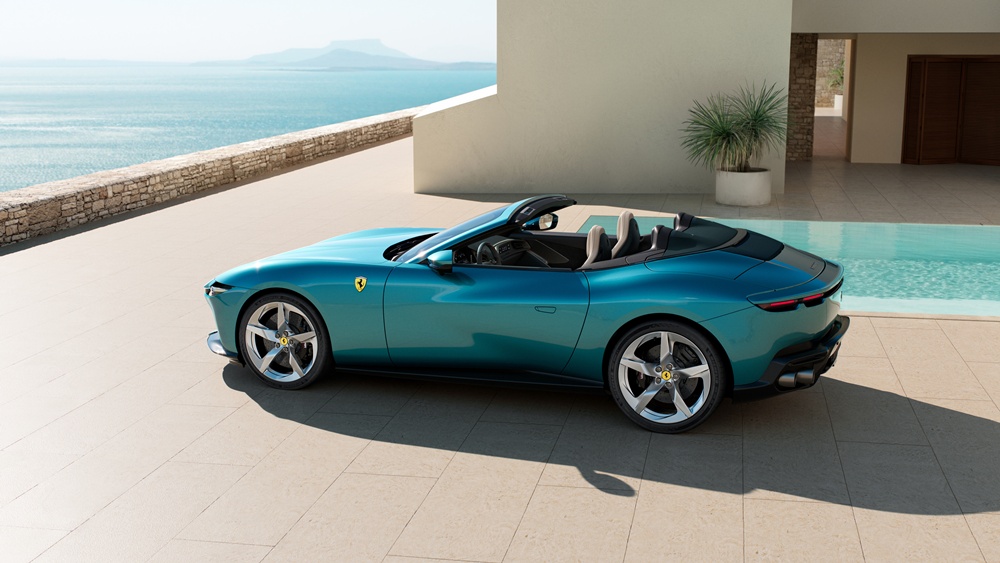
Aerodynamic stability is managed by an active rear spoiler integrated into the trailing edge of the boot lid. Its angle varies based on speed and longitudinal acceleration, providing 3 different levels of downforce to ensure the rear axle remains planted during high-speed cornering.
The front air intake and underbody channels work in tandem with this active system to maintain a neutral balance, allowing the car to transition smoothly between relaxed cruising and more aggressive driving.
The chassis and suspension have been recalibrated to account for the changes in rigidity inherent in a ‘topless’ design. Forged wheels and optional carbonfibre accents serve to reduce unsprung mass, while the Side Slip Control system manages the power delivery to the rear wheels.
![Ferrari Amalfi Spider [2026]](https://www.motaauto.com/wp-content/uploads/2026/03/Ferrari-Amalfi-Spider-2026-6.jpg)
The result is a vehicle that prioritizes a predictable, engaging driving experience across a wide range of environments, from coastal roads to city centres, without sacrificing the refinement expected of a modern Ferrari GT.