
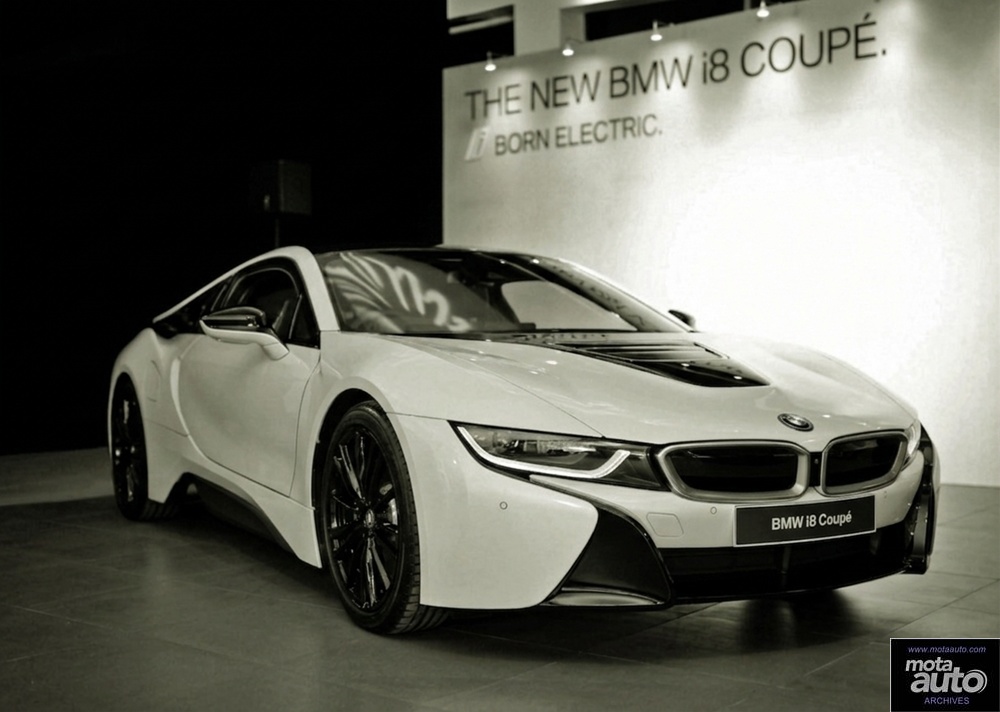
Hybrid electric vehicles (HEVs) are more common these days as many models have electrified powertrains. Although it’s only in the past few years that HEVs have been promoted more prominently in Malaysia, BMW Malaysia was already offering such powertrains 13 years ago.
Back in 2013, the company introduced the ActiveHybrid sedans and then the futuristic i8 a year later. Although the numbers sold were small, it was a first step towards electrification which the brand continued to promote.
High-voltage batteries in ‘afterlife’
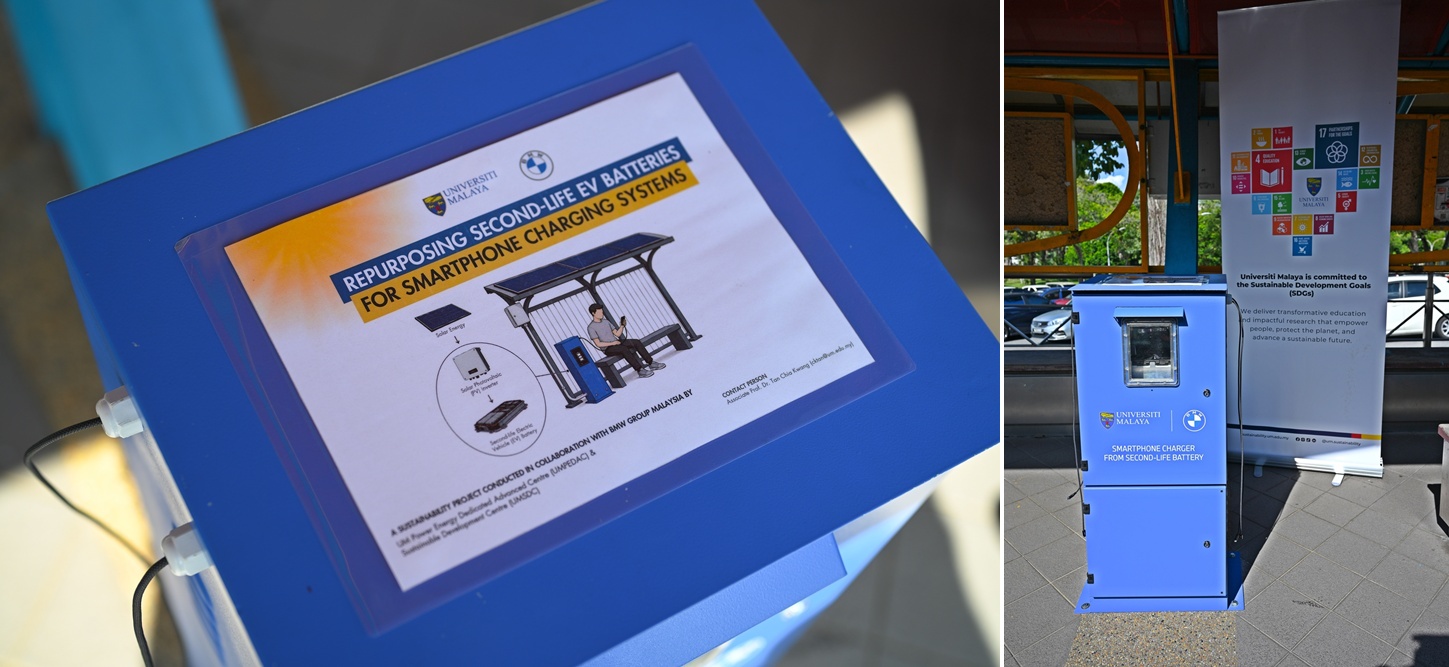
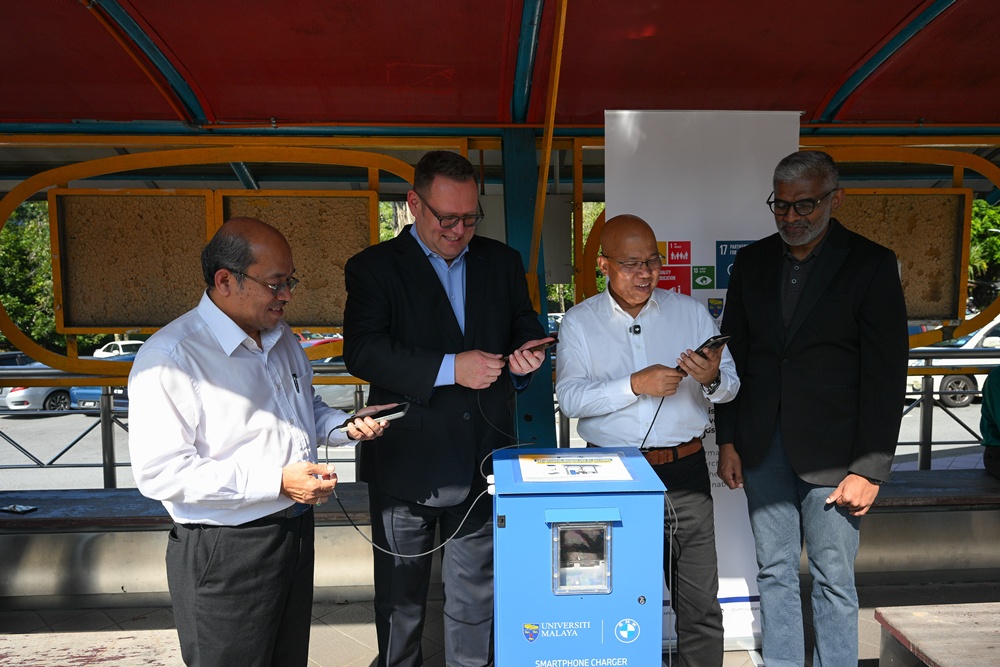
By now, the high-voltage batteries in those original cars are no longer usable for HEV application. However, they are not entirely useless that they need to be disposed. Instead, BMW Group Malaysia and Universiti Malaya are giving the batteries a ‘second life’ powering a solar-powered smartphone charging station.
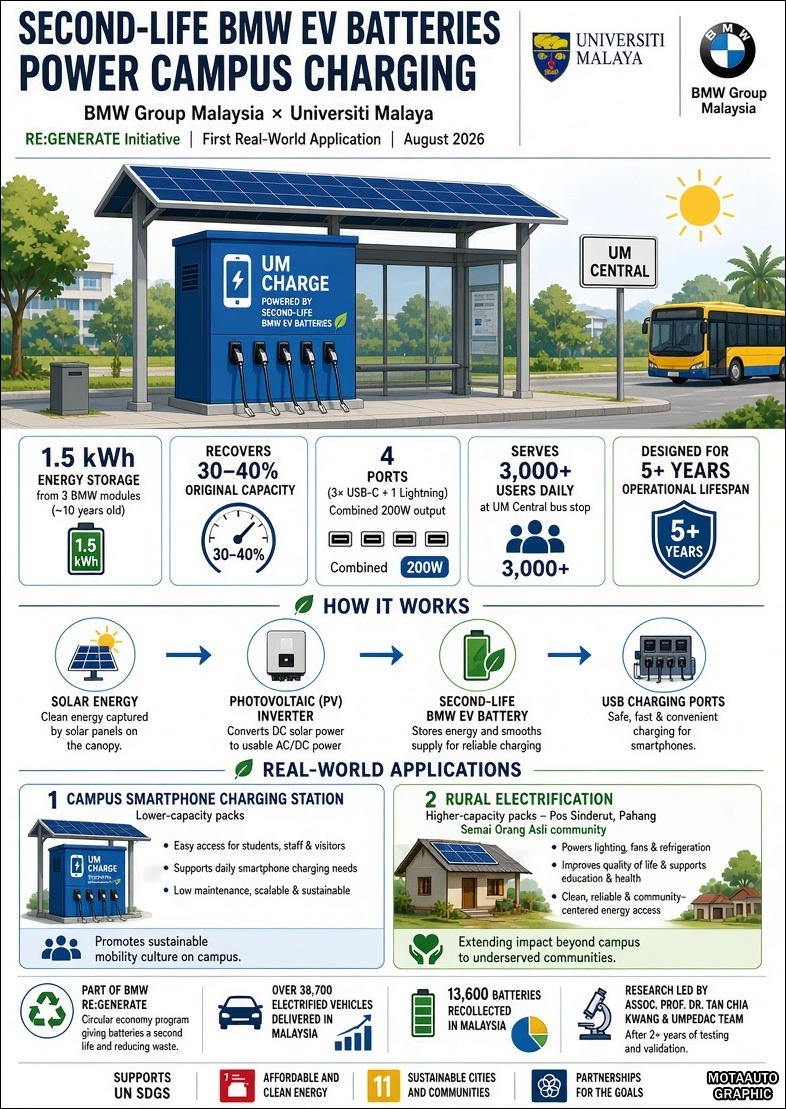
Designed by Associate Professor Dr. Tan Chia Kwang and his team at the UM Power Energy Dedicated Advanced Centre (UMPEDAC), the station is the result of over 2 years of laboratory research into a publicly accessible system serving more than 3,000 daily bus-stop users.
The set-up has a 1.5 kWh energy storage capacity constructed from three 10-year-old BMW battery modules, combined with second-life solar panels, a solar charge controller, a photovoltaic inverter, a battery management system, and a 200W USB fast charger offering 3 USB-C ports and one Lightning port.
Cell-level testing and grading by UMPEDAC recovered 30% to 40% of the batteries’ original capacity. By utilizing lower-capacity packs for the campus charger, degraded cells are put to practical use rather than being discarded early. Data loggers monitor usage and battery metrics, with maintenance managed by trained students to ensure an operational lifespan of at least 5 years.
Another application
While lower-capacity cells power this public charging station, higher-capacity battery packs retaining up to 80% of their original capacity are earmarked for off-grid electrification in Pos Sinderut, Pahang.
Once those higher-capacity batteries complete their second-life service in the rural village, researchers plan to repurpose them into third-life smartphone chargers, creating a full 3-stage lifecycle.

The RE:Generate Project Lifecycle
The collaboration forms the latest phase of BMW Group Malaysia’s RE:GENERATE initiative, an organizational commitment launched in October 2021 to integrate circular economy principles across operations.
The initiative aligns with BMW’s global sustainability framework focusing on rethinking, reducing, reusing, and recycling resources.
RE:GENERATE began internally when more than 200 associates upcycled household and office plastic waste into furniture for an Orang Asli school in partnership with Precious Plastic Malaysia.
In January 2022, the initiative expanded publicly through a lubricant recycling program with Pentas Flora, re-refining dealership waste oil into eco-base oil, alongside an EV battery second-life partnership with EV Connection.
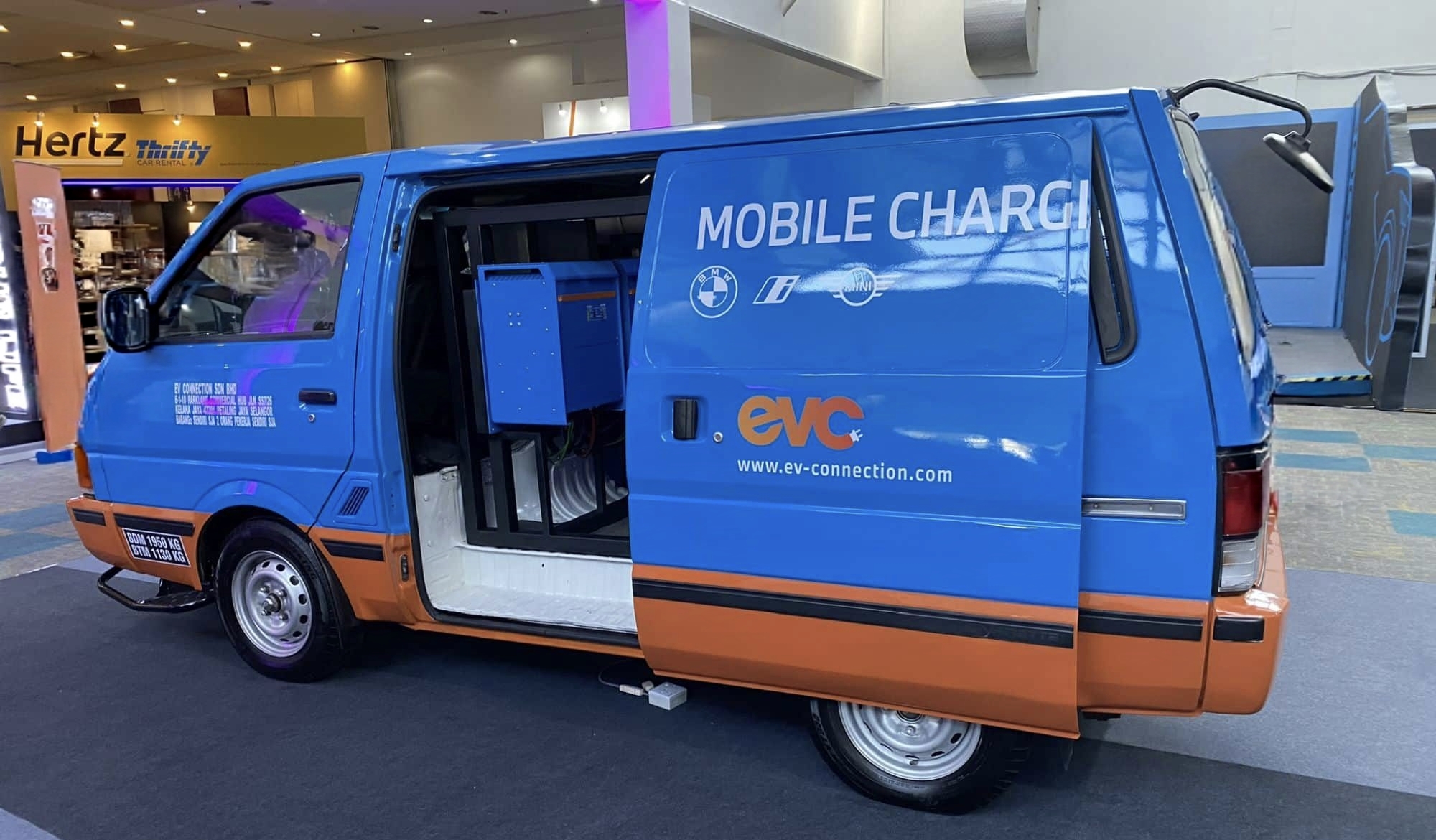
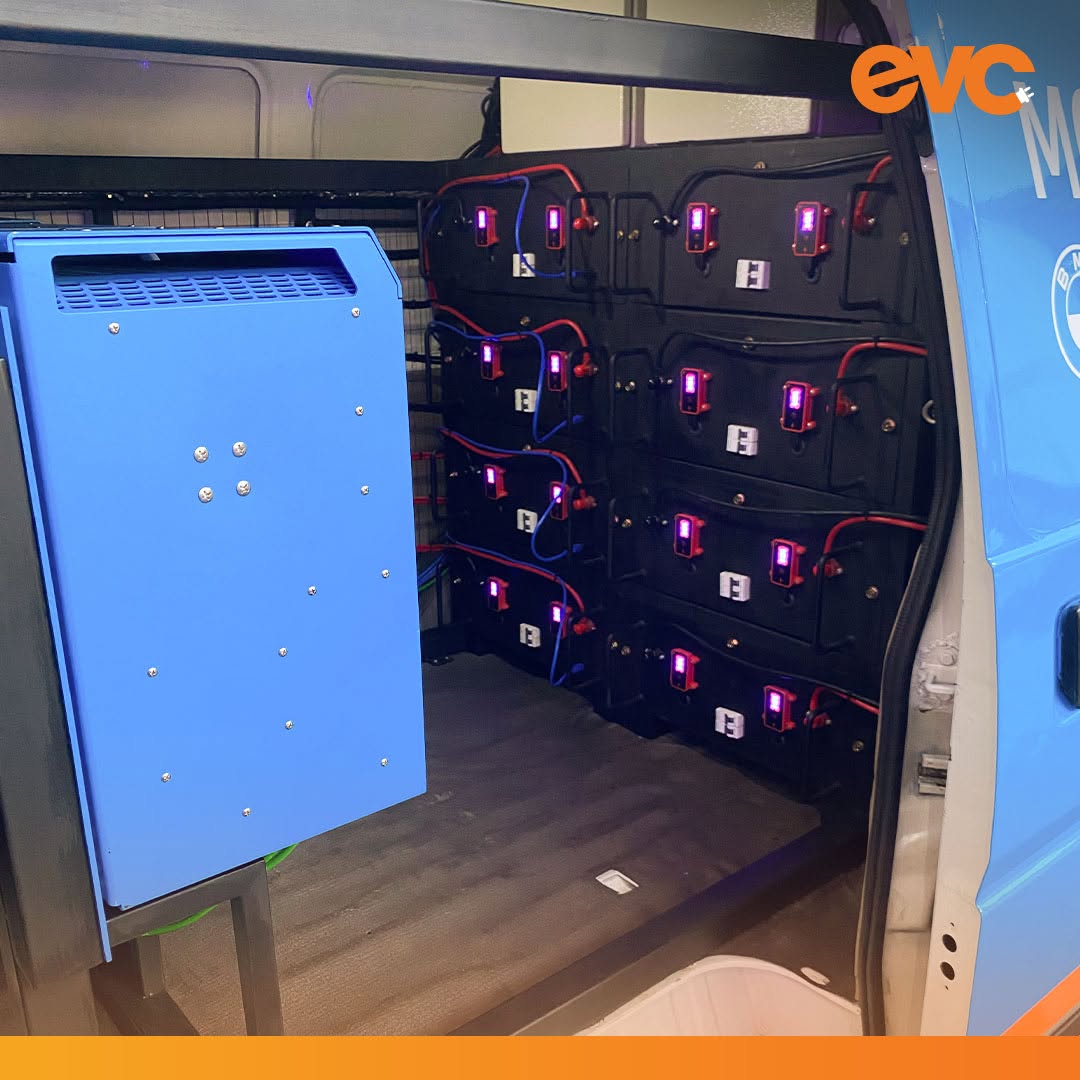
That collaboration with EV Connection led to the unveiling of Malaysia’s first Mobile Charging Vehicle at the Malaysia Autoshow 2023. Built using 16 repurposed BMW battery modules maintaining roughly 70% State of Health, the vehicle provides a 20 kWh capacity and a 30 kVA 3-phase AC output capable of rescuing stranded EVs or powering up to 8 homes during disaster relief.
In January 2026, BMW Group Malaysia signed a Memorandum of Understanding with Universiti Malaya, engaging UMPEDAC, the Community Engagement Centre, and the Sustainable Development Centre.
Under this framework, BMW supplies retired EV batteries — from a pool of over 13,600 recollected units (as of March 2026) — to UMPEDAC for engineering into solar-powered storage systems.
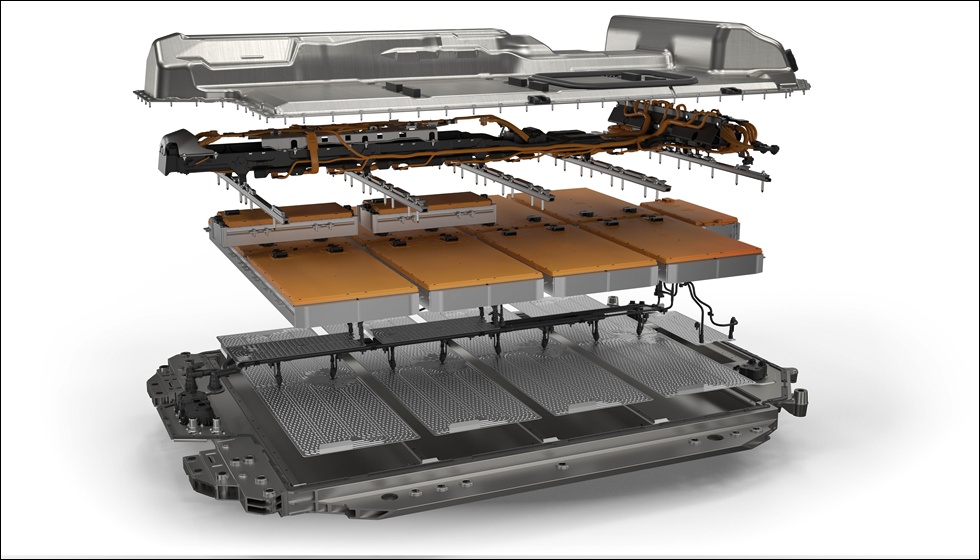
The primary destination for higher-capacity packs is Pos Sinderut, Kuala Lipis, Pahang, addressing energy poverty among the local Semai Orang Asli community.
The standalone energy storage units will power lighting, fans, and household refrigeration, allowing families to preserve hunted and gathered food safely. Testing reveals that newer-generation BMW battery packs yield higher energy density averaging 1.6 kWh per pack, compared to 0.5 kWh from older generations.
Beyond rural electrification, project partners are exploring early-stage plans to apply the second-life battery technology toward an autonomous zero-energy concept on a campus.